VERIZON STOCK OVERVIEW
SNAPSHOT
Ticker | VZ | Market Cap | $203B |
Sector | Telecommunications | P/E | 11.72 |
52 Week High-Low | $38.39 - $51.68 | 3 Year Beta | 0.49 |
CEO | Daniel H. Schulman | Target Price | $51.59 |

BUSINESS MODEL
Products Verizon Communications Inc. operates as a communications and technology provider structured primarily through its Consumer and Business segments, delivering wireless mobility services, fixed wireless access (FWA), fiber broadband (Fios), and enterprise connectivity solutions. The Consumer segment generates the majority of revenue (~77%) and includes postpaid and prepaid wireless plans, device sales, broadband, and digital services, while the Business segment (~21%) provides wireless, IoT connectivity, networking, security, and managed services to enterprises, government, and wholesale customers. The company also monetizes its network through equipment financing, wholesale access (MVNO relationships), and bundled offerings, with recurring subscription revenue forming the economic core of the model. |
Customer Base Verizon serves a highly diversified base of consumers, enterprises, public sector entities, and wholesale clients, with approximately 116 million wireless retail connections and over 14 million broadband connections. The customer base is heavily weighted toward postpaid wireless users (~83%), which provides stable recurring revenue, while enterprise clients rely on Verizon for mission-critical connectivity, IoT, and network infrastructure. Demand is driven by data consumption growth, 5G adoption, cloud integration, and enterprise digitization, with retention and network quality serving as primary competitive differentiators. |
Pricing Method Pricing is primarily subscription-based, with tiered wireless plans, bundled services, and promotional incentives such as device trade-ins and installment financing. Verizon uses price differentiation across premium, mid-tier, and value offerings, alongside contract-based pricing for enterprise clients. Promotional intensity remains high, with price locks, bundled content, and discounting strategies used to compete for market share in a saturated wireless market. |
Supply Chain Verizon depends on a global ecosystem of network equipment providers, semiconductor manufacturers, and device suppliers to support its wireless and fiber infrastructure. The company must continuously invest in spectrum, network densification, fiber deployment, and 5G expansion, making it highly sensitive to supply chain disruptions, vendor concentration, and technological shifts. Infrastructure deployment requires coordination across vendors, regulators, and local authorities, reinforcing the capital-intensive nature of operations. |
Sales Channels Revenue is generated through a mix of direct retail stores, digital platforms, enterprise sales teams, resellers, and wholesale partnerships. The company utilizes omni-channel distribution, including company-operated stores, third-party retailers, and digital interfaces enhanced by AI-driven customer engagement. Enterprise sales rely on direct relationships and solution-based selling, while wholesale channels extend network monetization through third-party providers. |
INDUSTRY ANALYSIS: PORTER'S 5 FORCES
Porter’s Five ForcesThreat of New Entrants — Low Barriers to entry in telecommunications remain extremely high due to the massive capital requirements associated with building nationwide wireless and fiber infrastructure, acquiring spectrum licenses, and navigating complex regulatory environments. Verizon benefits from decades of investment in network density and spectrum assets, creating a scale advantage that is nearly impossible for new entrants to replicate. While niche or regional providers can emerge in limited segments, the likelihood of a new full-scale national competitor entering the market is minimal. |
Bargaining Power of Buyers — High Buyer power is elevated in a saturated market where growth is driven largely by customer switching rather than new subscriber additions. Consumers can easily compare pricing, promotions, and service quality across providers, and switching costs are relatively low due to number portability and standardized offerings. Aggressive promotions and bundled services further increase customer leverage, while enterprise clients exert additional pressure through large contracts and competitive bidding. Verizon relies on network quality and bundling to retain customers, but pricing sensitivity remains a key challenge. |
Bargaining Power of Suppliers — Moderate Suppliers, particularly those providing network infrastructure and advanced technology components, have some leverage due to the limited number of vendors capable of supporting large-scale telecom operations. However, Verizon’s scale, long-term contracts, and diversified supplier base reduce dependency on any single provider. Ongoing shifts toward network virtualization and alternative architectures may further limit supplier power over time. |
Threat of Substitutes — Moderate to High Substitution risk is increasing as alternative connectivity solutions and digital platforms expand. Cable companies offering wireless services, fixed wireless access, satellite internet, and cloud-based communication tools all compete with traditional telecom offerings. Additionally, consumers increasingly rely on internet-based applications for communication, reducing dependence on legacy voice and messaging services. Verizon mitigates this through diversification, but substitution pressure remains structurally elevated. |
Competitive Rivalry — High Competition is intense in a mature, highly concentrated market dominated by a few large players. Verizon competes directly with AT&T and T-Mobile in wireless, as well as with cable and technology firms in broadband and enterprise services. Rivalry is driven by pricing, promotions, network performance, and bundled offerings, with limited industry growth intensifying the focus on market share gains. The convergence of telecom and technology services further increases competitive pressure, making sustained differentiation more difficult. |
VALUATION: DISCOUNTED CASH FLOW


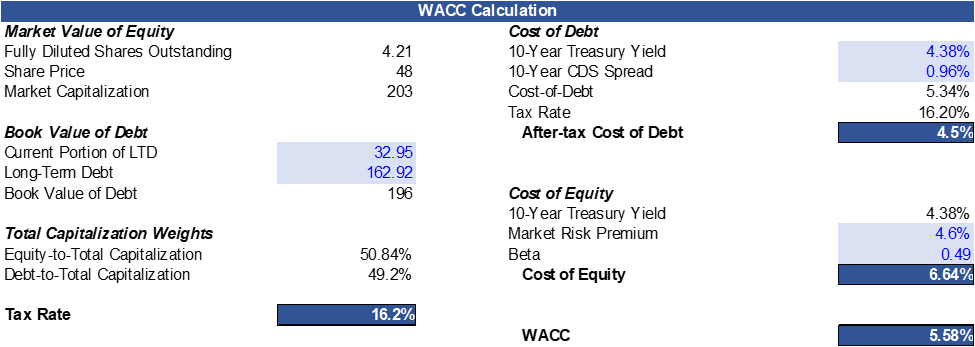
WACC
INVESTMENT RISKS
Systematic Risk |
Market Risk: Verizon trades at a P/E of 11.72x, EV/EBITDA of 7.01x, and EV/Sales of 2.56x with a WACC of 5.43%, reflecting a relatively stable but low-growth valuation profile. Operating margins remain strong at 23.12% and net margins at 12.46%, while free cash flow margin stands at 14.57%, indicating consistent cash generation. However, modest valuation multiples and price-to-sales of 1.52x suggest limited growth expectations, and revenue expansion remains constrained by market saturation despite stable profitability. |
Geopolitical Risk: Geopolitical risk is moderate, primarily driven by global supply chain exposure, international operations, and regulatory environments. Trade tensions, tariffs, and supply disruptions could increase equipment costs and delay network deployment, while macroeconomic conditions such as inflation and interest rates may impact consumer demand and enterprise spending. |
Unsystematic Risk |
Business Risk: Business risk is moderate due to high capital intensity, evolving technology, and competitive pressures. Asset turnover remains low at 0.35x, reflecting heavy infrastructure investment, while return on invested capital is 6.84%, indicating moderate efficiency relative to capital employed. Continued investment in 5G, fiber expansion, and network virtualization introduces execution risk, particularly as legacy services decline and competition intensifies. |
Financial Risk: Financial risk is elevated given leverage and ongoing capital requirements. Net debt to EBITDA is approximately 3.23x and total debt to EBITDA around 3.39x, indicating a leveraged capital structure. Interest coverage of approximately 4.19x provides moderate debt servicing capacity, while CFO to total debt at 0.19x highlights reliance on sustained cash flows. Although leverage is manageable, continued investment and dividend commitments constrain financial flexibility. |
Liquidity Risk: Liquidity is constrained, with a current ratio of 0.59x and quick ratio of 0.56x, indicating limited short-term coverage of liabilities. CFO to current liabilities at 53.43% provides some operational support, but capital expenditures and spectrum investments reduce liquidity headroom and increase dependence on consistent cash generation. |
Regulatory Risk: Regulatory risk is high due to extensive oversight by the FCC and other authorities governing spectrum usage, pricing, broadband access, and data privacy. Verizon operates under complex federal, state, and local regulations, including requirements related to network reliability, cybersecurity, and consumer protection, which can impact operations, costs, and strategic flexibility. |
MANAGEMENT
Daniel H. Schulman
Chief Executive Officer & Director
Daniel became CEO of Verizon in 2025, bringing extensive experience from the technology and payments industries, most notably as CEO of PayPal from 2014 to 2023 and previously as CEO of Virgin Mobile USA. His background combines telecommunications, fintech, and platform-based business models, positioning him to drive Verizon’s strategic evolution beyond traditional connectivity into digital services and ecosystem-based offerings. Schulman has also held leadership roles at Priceline and eBay, giving him deep expertise in scaling consumer platforms, digital transformation, and monetization strategies. His appointment signals a strategic emphasis on innovation, customer-centric services, and leveraging Verizon’s network as a platform for broader digital growth.
__________________________________________________________________________________
Anthony T. Skiadas
Chief Financial Officer & Executive Vice President
Anthony has served as CFO since 2023 and brings a strong accounting and financial management background, supported by his CPA credentials and prior experience within Verizon since 2013. His tenure reflects deep familiarity with the company’s financial structure, capital allocation strategy, and operational performance. Skiadas is responsible for managing Verizon’s balance sheet, optimizing capital expenditures, and maintaining dividend sustainability while navigating a highly leveraged environment. His role is critical in balancing the company’s investment in 5G and fiber infrastructure with the need for financial discipline and shareholder returns.
__________________________________________________________________________________
Santiago Tenorio
Chief Technology Officer & SVP Strategy and Technology Enablement
Santiago oversees Verizon’s technology strategy, network architecture, and innovation initiatives. Appointed CTO in 2024, he is responsible for advancing 5G deployment, network virtualization, and emerging technologies that enhance capacity and efficiency. His role integrates long-term strategic planning with operational execution, ensuring that Verizon’s infrastructure investments align with evolving technological demands. His leadership is central to maintaining network competitiveness and enabling future growth opportunities in areas such as AI-driven networks and advanced connectivity solutions.
__________________________________________________________________________________
Alfonso Villanueva
Chief Transformation Officer & Executive Vice President
Alfonso joined Verizon in 2025 as Chief Transformation Officer, bringing experience from PayPal and McKinsey where he focused on corporate development, strategy, and operational transformation. His role centers on driving efficiency, cost optimization, and strategic realignment across Verizon’s business segments. Villanueva is tasked with executing large-scale transformation initiatives aimed at improving margins, simplifying operations, and positioning the company for long-term growth in a highly competitive industry.
__________________________________________________________________________________
Leslie Berland
Chief Marketing Officer & Executive Vice President
Leslie serves as Chief Marketing Officer and leads Verizon’s brand strategy, advertising, and customer engagement initiatives. With prior experience at Peloton, Twitter (X), and American Express, she brings expertise in digital marketing, brand positioning, and consumer engagement. Her role focuses on differentiating Verizon’s offerings in a saturated market, driving customer acquisition, and enhancing brand loyalty through integrated marketing strategies aligned with Verizon’s network and service capabilities.
__________________________________________________________________________________
Samantha Hammock
Chief Human Resources Officer & Executive Vice President
Samantha has served as CHRO since 2021 and is responsible for talent strategy, workforce development, and organizational culture. With prior leadership experience at American Express, she brings expertise in talent management and organizational transformation. Her role is particularly important as Verizon undergoes workforce restructuring and strategic realignment, including large-scale cost reduction initiatives and investments in high-skill areas such as technology and network operations. She plays a key role in aligning human capital with Verizon’s long-term strategic priorities and maintaining workforce engagement during periods of change.
__________________________________________________________________________________
Find Verizon's 10 Year Financial Statements below.


