MICROSOFT STOCK OVERVIEW
Updated: Jun 7

SNAPSHOT
last updated on 5/17/2026
Ticker | MSFT | Market Cap | $3.1T |
Sector | Software and Consulting | P/E | 25.13 |
52 Week High-Low | $356.28 - $555.45 | 3 Year Beta | 1.04 |
CEO | Satya Nadella, MBA | Target Price | $564.83 |

BUSINESS MODEL
Products Microsoft sells enterprise software, cloud infrastructure, productivity applications, operating systems, and hardware. Its core offerings include cloud services through Azure, productivity and collaboration software such as Microsoft 365, operating systems (Windows), business applications (Dynamics), developer tools, and gaming content and platforms (Xbox). Increasingly, Microsoft integrates artificial intelligence capabilities across its product suite to enhance functionality and lock-in. |
Customer Base Microsoft serves a broad range of customers including individual consumers, small and medium-sized businesses, large enterprises, governments, and developers. Enterprise and public-sector clients are the most economically important group, particularly for Azure, Microsoft 365, and Dynamics. Consumers primarily engage through Windows, Office subscriptions, gaming, and devices, while developers rely on Azure and developer tools. |
Pricing Method Microsoft primarily uses subscription-based and usage-based pricing. Microsoft 365 and Dynamics are sold through recurring subscription licenses, Azure is priced based on consumption of computing, storage, and data services, and enterprise agreements often involve multi-year contracts. Consumer software and gaming content are sold via subscriptions, licenses, or digital transactions. This recurring revenue model provides high visibility and stability. |
Supply Chain Microsoft’s key resources include its cloud infrastructure, proprietary software platforms, intellectual property, and engineering talent. It relies on data centers, semiconductor suppliers, hardware manufacturers, and energy providers to support cloud operations. Strategic partners include enterprise customers, software developers, system integrators, and hardware OEMs. Scale, ecosystem integration, and long-term enterprise relationships are central to Microsoft’s operating efficiency. |
Sales Channels Microsoft distributes products through direct sales to enterprises, digital subscriptions, cloud-based delivery, and a global partner ecosystem. Enterprise software and cloud services are sold via account teams and partners, while consumer products are distributed digitally through online platforms and pre-installed software. Azure and SaaS offerings are delivered entirely through Microsoft’s global data center network. |
INDUSTRY ANALYSIS: PORTER'S 5 FORCES
Threat of New Entrants — Low Microsoft operates in markets characterized by high capital requirements, strong network effects, deep customer relationships, and significant switching costs. Building a global cloud platform, enterprise software ecosystem, or operating system at scale requires massive investment and long development timelines. While startups can enter niche software segments, meaningful competition at Microsoft’s scale is unlikely. |
Bargaining Power of Buyers — Moderate Large enterprise and government customers can negotiate pricing, particularly for cloud services and enterprise agreements, and may adopt multi-cloud or multi-vendor strategies. However, Microsoft’s integrated product suite, high switching costs, and mission-critical role in business operations reduce buyer leverage. Individual consumers have limited bargaining power but can switch between competing productivity or gaming platforms at low cost. |
Bargaining Power of Suppliers — Moderate Microsoft depends on semiconductor manufacturers, hardware vendors, data center equipment suppliers, and energy providers to operate its cloud infrastructure. While some suppliers have pricing power, Microsoft’s scale, long-term contracts, and ability to design custom hardware mitigate supplier influence. Talent availability, particularly in AI and cloud engineering, also represents a key supplier constraint. |
Threat of Substitutes - Moderate Businesses can substitute Microsoft products with competing cloud providers, open-source software, or alternative productivity tools, while consumers can shift to competing operating systems or platforms. However, Microsoft’s ecosystem integration, compatibility standards, and enterprise entrenchment reduce the practical attractiveness of substitutes for many customers. |
Competitive Rivalry — High Microsoft competes across multiple highly contested markets, including cloud computing (Azure vs AWS and Google Cloud), productivity software (Microsoft 365 vs Google Workspace), operating systems, enterprise applications, and gaming. Competition is driven by pricing, innovation, platform integration, and ecosystem depth. While Microsoft benefits from scale, brand strength, and enterprise lock-in, rivalry remains intense due to well-capitalized competitors and rapid technological change. |
VALUATION: DISCOUNTED CASH FLOW


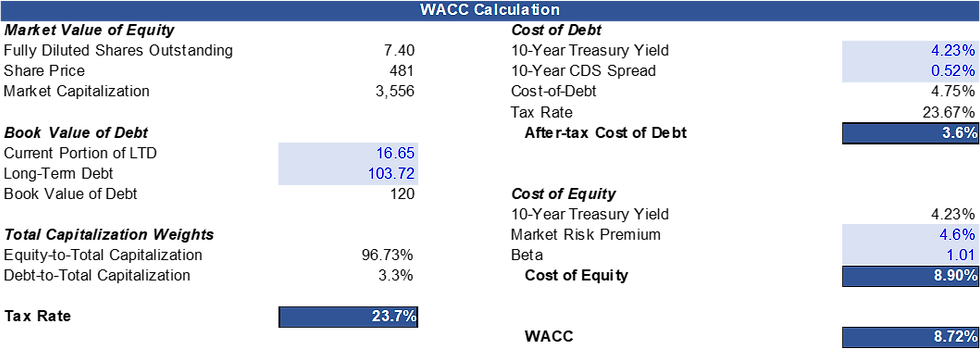
WACC
INVESTMENT RISKS
Systematic Risk |
Market Risk: The stock market is currently trading near record highs, supported by optimism about continued short-term growth. However, a significant portion of total market value is concentrated in just ten major companies, according to the Wall Street Journal. Microsoft is one of these top firms and plays a central role in this market concentration.
This strong momentum increases Microsoft’s exposure to overall market movements. With a three-year beta of 1.02, Microsoft tends to move closely with the broader market. If equity markets were to decline, Microsoft’s stock would likely follow, given its size, visibility, and integration within the global technology economy. |
Geopolitical Risk: Like all multinational corporations, Microsoft faces risks related to geopolitical instability. Around 11 percent of its revenue comes from Mainland China, creating potential exposure to rising tensions between the United States and China. Any deterioration in trade relations, data restrictions, or technology sanctions could disrupt operations, supply chains, or access to local markets. |
Unsystematic Risk |
Business Risk: Microsoft’s business risk remains relatively low, supported by its diversified revenue streams and experienced leadership team. The company’s management, including its CEO and Vice Chairman, brings more than six decades of combined tenure within the firm. This level of experience provides strong strategic oversight and long-term vision.
However, recent financial trends suggest some challenges in maintaining profitability efficiency. While Microsoft continues to increase investment in research and development and capital expenditures, its profitability metrics have declined over time. Return on equity, return on assets, and return on invested capital have all fallen, with ROE dropping by roughly 14 percentage points over the past seven years. These trends raise questions about whether the firm can convert its elevated investment levels into shareholder value at a scale that justifies its high market valuation. |
Financial Risk: Microsoft holds an AAA credit rating from Standard & Poor’s, reflecting its exceptional financial stability. The company has consistently reduced leverage over the years, with its long-term debt to total equity ratio decreasing from 99 percent to 29 percent. Total debt to total capital has also fallen steadily, while debt now represents less than 20 percent of total assets. Combined with strong free cash flow generation, these figures position Microsoft among the lowest financial risk companies in the S&P 500. |
Liquidity Risk: Although Microsoft’s liquidity ratios have declined in recent years, its overall liquidity position remains strong. The company generates substantial operating cash flow and maintains ample cash reserves, allowing it to fund operations and meet obligations comfortably. The risk of operational disruption arising from liquidity constraints is therefore low to moderate. |
Regulatory Risk: Microsoft faces meaningful regulatory risk due to its global scale, market influence, and presence across software, cloud computing, artificial intelligence, and gaming. Antitrust scrutiny in the United States, European Union, and other jurisdictions may result in fines, behavioral remedies, or restrictions on bundling and platform integration, particularly involving Windows, Microsoft 365, and Azure. In addition, expanding regulation related to data privacy, cybersecurity, artificial intelligence governance, and cross-border data transfers could increase compliance costs and constrain product design or deployment. Regulatory oversight of large technology platforms, especially around competition and AI usage, poses an ongoing risk to Microsoft’s operational flexibility and long-term growth. |
MANAGEMENT
Satya Nadella, MBA
Chairman & Chief Executive Officer
Satya has served as Chairman and Chief Executive Officer of Microsoft Corp. since 2021. He joined the company in 1992 and has led major transformations, including Microsoft’s transition to cloud computing and AI-driven innovation. Beyond Microsoft, he serves as Trustee at the University of Chicago and previously held board positions at Starbucks and Fred Hutchinson Cancer Research Center. Nadella holds an MBA from the University of Chicago Booth School of Business, a master’s in computer science from the University of Wisconsin–Milwaukee, and a bachelor’s in electrical engineering from Mangalore University.
__________________________________________________________________________________
Bradford L. Smith
President & Vice Chairman
Brad has been with Microsoft since 1993 and currently serves as President and Vice Chairman. He oversees the company’s legal, corporate, and social responsibility initiatives and is a leading advocate for responsible technology governance. Smith also serves on the boards of Netflix, Code.org, and Princeton University, among others, and co-founded Kind, Inc. He previously worked as an attorney at Covington & Burling LLP. Smith earned his undergraduate degree from Princeton University and his law degree from Columbia Law School.
__________________________________________________________________________________
Carolina Dybeck-Happe
Chief Operating Officer & Executive Vice President
Carolina joined Microsoft as Chief Operating Officer and Executive Vice President in 2024. She previously served as Chief Financial Officer and Executive Vice President at ASSA ABLOY AB, where she also chaired several of its subsidiary boards. Earlier in her career, she held senior finance roles at Trelleborg AB and A.P. Moller–Maersk. Ms. Dybeck-Happe has also served as an Independent Director at Ericsson and Telefonaktiebolaget L.M. Ericsson. She brings extensive international experience in corporate finance, governance, and operational management.
__________________________________________________________________________________
Amy E. Hood, MBA
Chief Financial Officer & Executive Vice President
Amy has served as Microsoft’s Chief Financial Officer and Executive Vice President since 2013 and has been with the company since 2002. She is responsible for leading Microsoft’s global finance organization and strategic planning. Before joining Microsoft, she worked at Goldman Sachs & Co. LLC and currently serves as an Independent Director for 3M Company and on the board of United Way of King County. Hood earned her MBA from Harvard University and her undergraduate degree in economics from Duke University.
__________________________________________________________________________________
David Rhew, MD
Global Chief Medical Officer & Vice President
Dr. Rhew serves as Global Chief Medical Officer and Vice President at Microsoft Corporation, a role he has held since 2019. He oversees Microsoft’s healthcare strategy and partnerships, advancing AI and cloud-based innovations in medicine. Before joining Microsoft, Dr. Rhew held senior positions at Samsung Electronics, Zynx Health, and various healthcare organizations. He has also served as Associate Clinical Professor at UCLA and as an advisor to several technology and health organizations. Dr. Rhew earned his M.D. from Northwestern University and his undergraduate degree from the University of Michigan.
__________________________________________________________________________________
James Kevin Scott, PhD
Chief Technology Officer
Dr. Kevin Scott has been Microsoft’s Chief Technology Officer since 2017, leading the company’s long-term technical strategy and AI initiatives. Before joining Microsoft, he held senior engineering roles at LinkedIn, Google, and AdMob. Dr. Scott also serves on multiple boards, including Shopify Inc., the Anita Borg Institute for Women & Technology, and The Scott Foundation. His previous directorships include Stellantis NV and Relativity ODA LLC. Dr. Scott earned his Ph.D. from Wake Forest University, his master’s degree from the University of Virginia, and his undergraduate degree from the University of Lynchburg.
__________________________________________________________________________________
Find Microsoft's 10 Year Financial Statements below.


