SALESFORCE STOCK OVERVIEW
SNAPSHOT
last updated on 6/28/2026
Ticker | CRM | Sector | Software and Consulting |
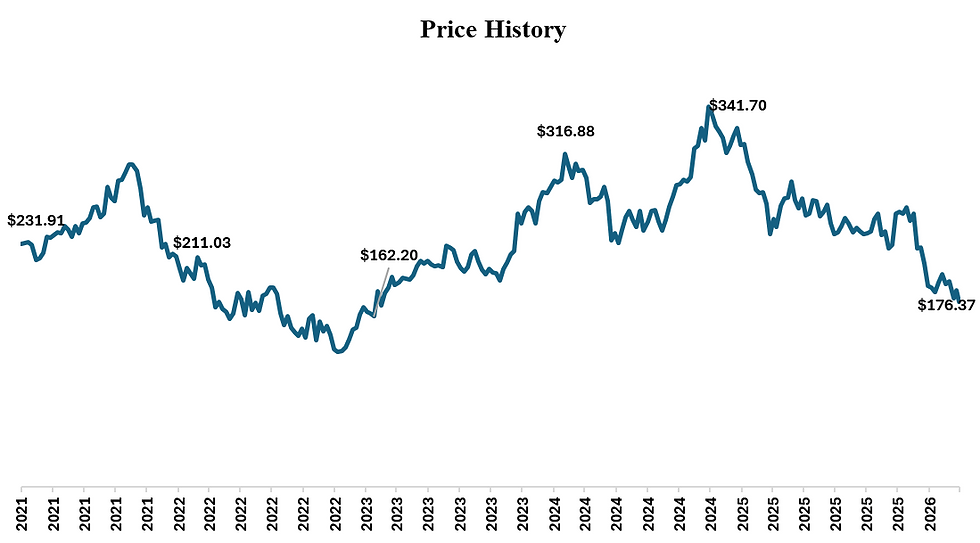
52 Week High-Low | $146.32 - $276.80 | Industry | CRM Software |
CEO | Marc Russell Benioff | Target Price | $230.19 |
BUSINESS MODEL
Products Salesforce, Inc. provides a comprehensive, cloud-based customer relationship management platform designed to unify data, applications, and artificial intelligence across the enterprise. Its core platform, Agentforce 360, integrates sales, service, marketing, commerce, analytics, integration, and data management into a single ecosystem, enabling businesses to manage customer interactions across the entire lifecycle. Key offerings include Agentforce Sales for sales automation and forecasting, Agentforce Service for customer support and case management, Marketing Cloud for personalized engagement, Commerce Cloud for digital storefronts, Tableau for analytics, MuleSoft for integration and API management, Slack as a collaboration interface, and Data 360 for unified data architecture. The platform is increasingly AI-driven, embedding autonomous agents and generative AI into workflows to automate tasks, improve decision-making, and enhance productivity, positioning Salesforce as a leader in enterprise AI-enabled CRM infrastructure. |
Customer Base Salesforce serves a global and highly diversified customer base across virtually all industries, including enterprises, small and medium-sized businesses, and public sector organizations. Customers range from single-seat users to large-scale enterprises with hundreds of thousands of subscriptions, and no single customer accounts for more than 10 percent of total revenue, indicating strong diversification. The company targets organizations undergoing digital transformation, helping them unify customer data, automate workflows, and deploy AI-driven solutions across sales, service, and operations. Its broad industry reach, combined with vertical-specific solutions for sectors such as healthcare, financial services, and manufacturing, allows Salesforce to capture demand across multiple economic segments and geographies. |
Pricing Method Salesforce operates primarily on a subscription-based pricing model, generating recurring revenue through SaaS subscriptions that are typically billed annually or multi-year. Pricing varies by product tier, functionality, user count, and enterprise customization, with additional revenue from professional services, support, and platform usage. The company also monetizes its ecosystem through partner applications sold via AppExchange and through usage-based pricing for certain AI, data, and integration services. This model provides high revenue visibility, strong customer retention, and scalability, but also creates sensitivity to renewal rates, upsell success, and enterprise spending cycles. |
Supply Chain Salesforce’s supply chain is fundamentally digital and cloud-based, relying on third-party infrastructure providers and data centers to deliver its services globally. The company leverages cloud computing partners and its Hyperforce infrastructure to ensure scalability, data residency compliance, and global availability. Unlike hardware companies, Salesforce’s primary “inputs” are computing infrastructure, software development talent, and data management capabilities. This reduces traditional manufacturing risks but introduces dependencies on cloud providers, cybersecurity systems, and continuous software development cycles. |
Sales Channels Salesforce sells primarily through a direct sales force organized by geography and customer segment, supported by a global network of partners including system integrators, consultants, and independent software vendors. The company also utilizes indirect channels such as AppExchange and partner-led implementations to expand its reach. Marketing is driven through large-scale events such as Dreamforce, digital campaigns, and ecosystem engagement via its Trailblazer community. This hybrid go-to-market strategy enables both enterprise penetration and scalable global distribution. |
INDUSTRY ANALYSIS: PORTER'S 5 FORCES
Threat of New Entrants — Moderate The threat of new entrants is moderate because while cloud computing lowers infrastructure barriers, competing at Salesforce’s scale requires significant investment in platform integration, AI capabilities, ecosystem development, and enterprise trust. Salesforce benefits from strong network effects, high switching costs, and an established ecosystem, but AI-native startups and cloud-native competitors can enter specific niches such as analytics, automation, or vertical SaaS. |
Bargaining Power of Buyers — High Buyers have strong bargaining power due to the availability of competing enterprise software vendors and the ability of large customers to negotiate pricing and contract terms. Enterprises often adopt multi-vendor strategies and can switch between platforms such as Microsoft, Oracle, SAP, and emerging AI-driven solutions. Subscription-based pricing further increases buyer leverage, as customers can renegotiate or reduce usage at renewal. |
Bargaining Power of Suppliers — Moderate Supplier power is moderate as Salesforce depends on cloud infrastructure providers, data center operators, and software development talent. While the company can diversify across providers, reliance on hyperscale cloud infrastructure introduces some concentration risk. Additionally, competition for skilled engineers and AI talent increases input costs and creates operational pressure. |
Threat of Substitutes — High The threat of substitutes is high due to the rapid evolution of enterprise software and AI-driven platforms. Companies can replace Salesforce with in-house solutions, alternative SaaS providers, or emerging AI-native platforms that bypass traditional CRM workflows. Additionally, bundled offerings from hyperscalers and productivity platforms can reduce the need for standalone CRM systems. |
Competitive Rivalry — Very High Competitive rivalry is extremely intense, as Salesforce operates in a fragmented and rapidly evolving market with numerous global competitors across CRM, analytics, integration, and AI. Competitors include Microsoft, Oracle, SAP, and a growing number of AI-native startups. The industry is characterized by constant innovation, aggressive pricing, and convergence across software categories, requiring continuous investment to maintain leadership. |
VALUATION: DISCOUNTED CASH FLOW


INVESTMENT RISKS
Systematic Risk |
Market Risk: Salesforce's market risk reflects both valuation normalization and improving but still maturing profitability. The company trades at a more reasonable valuation relative to prior years across earnings, EV/EBITDA, and price to sales, but remains dependent on sustained margin expansion. Profitability has improved materially, with operating margin and net margin both rising from 2024 to 2026. However, these gains follow historically low margins, meaning the market is pricing in continued efficiency improvements, and any slowdown in margin expansion or revenue growth could lead to valuation compression. |
Geopolitical Risk: Salesforce faces geopolitical risk due to its global operations and reliance on international customers, cloud infrastructure, and data regulations. The company operates in multiple jurisdictions subject to data privacy laws, data localization requirements, and cross-border data transfer restrictions. Currency fluctuations, trade policies, and geopolitical tensions can affect revenue growth and operating costs. Additionally, compliance with regional regulations such as GDPR and evolving AI governance frameworks introduces complexity and potential legal exposure. |
Unsystematic Risk |
Business Risk: Salesforce's business risk is centered on execution in scaling profitability, integrating acquisitions, and maintaining growth in a highly competitive and rapidly evolving market. While free cash flow margin has improved significantly, indicating strong cash generation, return on invested capital and return on assets remain moderate, suggesting capital efficiency is still developing. The company also faces risks related to customer attrition, longer enterprise sales cycles, and the complexity of implementing large-scale solutions. Additionally, the integration of acquisitions such as Informatica introduces execution risk and potential disruption if expected synergies are not realized. |
Financial Risk: Salesforce's financial risk is moderate, with improving but still relatively modest returns compared to mature software peers. Return on equity has increased, while asset turnover remains low, reflecting a capital-intensive growth model with significant investments in infrastructure and acquisitions. Debt metrics have improved, with net debt to EBITDA at a manageable level, but variability in prior years suggests sensitivity to cash flow and capital allocation decisions. Overall, the balance sheet is stable, but continued profitability improvements are necessary to justify capital deployment. |
Liquidity Risk: Salesforce's liquidity risk is moderate, supported by strong operating cash flow but constrained by relatively tight short-term ratios. The current ratio is below one, indicating limited short-term asset coverage relative to liabilities, while CFO to current liabilities remains solid, suggesting that operating cash flow is sufficient to meet obligations. Free cash flow per share has grown significantly, reinforcing liquidity strength, but reliance on continued subscription renewals and cash flow generation remains critical. |
Regulatory Risk: Salesforce faces significant regulatory risk due to its role in managing sensitive customer data and operating across global jurisdictions. The company is subject to regulations related to data privacy, cybersecurity, AI governance, and cloud infrastructure compliance. Its platform must adhere to strict standards for security, availability, and data protection, and any failure could result in legal liability, reputational damage, and loss of customer trust. As AI adoption increases, regulatory scrutiny is likely to intensify, particularly around data usage, algorithm transparency, and ethical AI deployment. |
MANAGEMENT
Marc Russell Benioff
Chairman and Chief Executive Officer
Marc is the founder of Salesforce and has served as Chairman and Chief Executive Officer since 1999, making him one of the longest-tenured leaders in enterprise software. He pioneered the SaaS model and transformed Salesforce into a global leader in cloud computing and CRM. His leadership has driven the company’s evolution from a sales automation platform into a comprehensive enterprise cloud and AI ecosystem. He is also an influential figure in technology and philanthropy, with leadership roles across multiple organizations and initiatives.
__________________________________________________________________________________
Robin L. Washington
Co-President, Chief Financial Officer, Chief Operating Officer and Director
Robin has served as Co-President, CFO, COO, and Director since 2023 and brings extensive financial and operational experience from leadership roles across major corporations. Her responsibilities include overseeing financial strategy, operational execution, and corporate governance. Her background includes senior leadership roles at Gilead Sciences and experience across multiple boards, providing strong oversight of financial discipline and operational scalability.
__________________________________________________________________________________
Srinivas Tallapragada
Co-President and Chief Engineering Officer
Srinivas has served as Co-President and Chief Engineering Officer since 2019, leading Salesforce’s global engineering organization. He oversees product development, platform architecture, and AI integration, playing a critical role in scaling the Agentforce platform and embedding AI across Salesforce’s offerings. His prior experience includes leadership roles at Oracle and SAP, contributing to his deep expertise in enterprise software engineering.
__________________________________________________________________________________
Patrick Stokes
Co-President and Chief Marketing Officer
Patrick serves as Co-President and Chief Marketing Officer, leading Salesforce’s global marketing strategy and brand positioning. He brings experience from technology and enterprise software companies, focusing on go-to-market execution, product positioning, and customer engagement. His role is central to driving demand generation and expanding Salesforce’s global presence.
__________________________________________________________________________________
Sabastian V. Niles
Co-President and Chief Legal Officer
Sabastian serves as Co-President and Chief Legal Officer, overseeing legal strategy, compliance, and corporate governance. His responsibilities include managing regulatory risk, legal operations, and corporate transactions, ensuring Salesforce operates within evolving global regulatory frameworks. His background includes leadership roles in law and corporate governance, supporting Salesforce’s global expansion.
__________________________________________________________________________________
Nathalie Scardino
Co-President and Chief People Officer
Nathalie serves as Co-President and Chief People Officer, responsible for human capital strategy, talent development, and organizational culture. She focuses on workforce development, diversity and inclusion, and aligning talent strategy with Salesforce’s long-term growth objectives. Her leadership supports Salesforce’s ability to attract and retain top talent in a competitive technology landscape.
__________________________________________________________________________________
Find Salesforce's 10 Year Financial Statements below.


