PEPSICO STOCK OVERVIEW

SNAPSHOT
last updated on 6/28/2026
Ticker | PEP | Sector | Food Production |
52 Week High-Low | $127.60 - $171.48 | Industry | Sweets and Snacks Production |
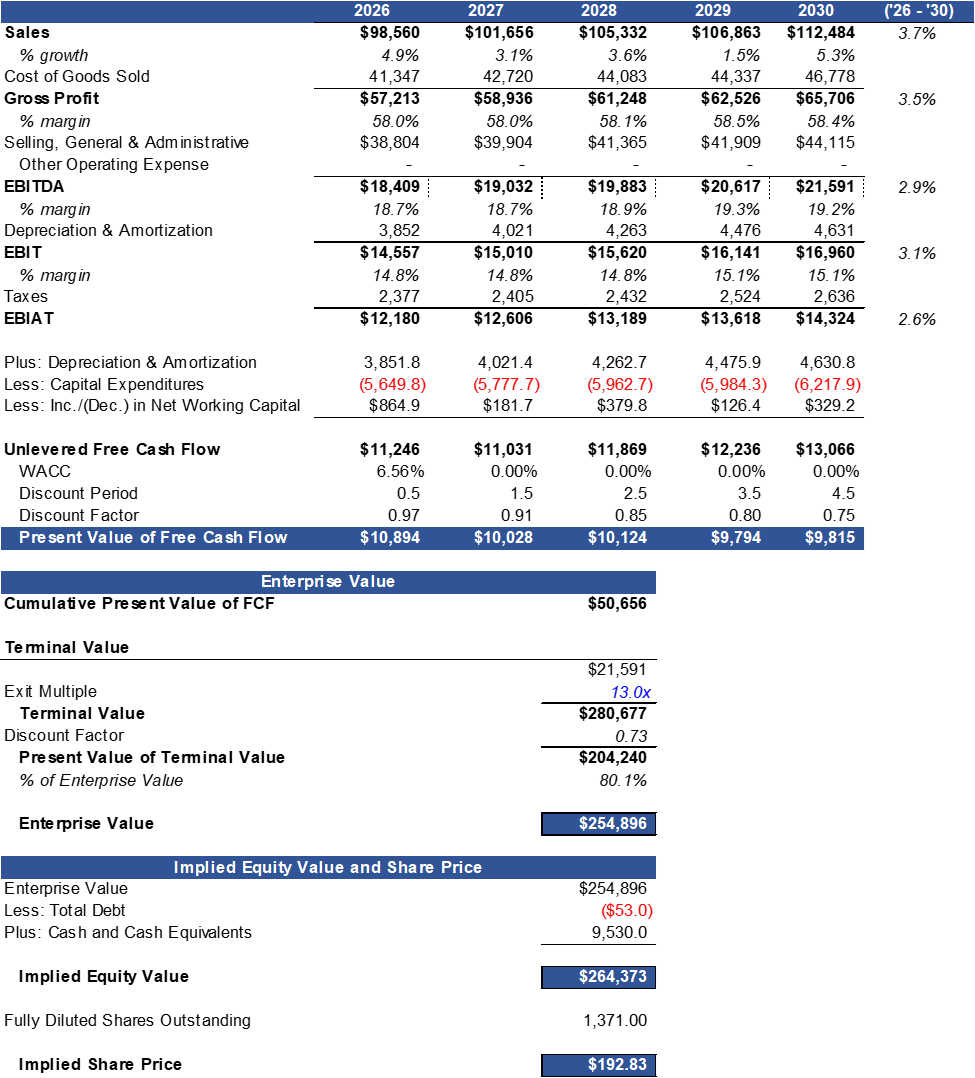
CEO | Ramon Luis Laguarta | Target Price | $192.83 |

BUSINESS MODEL
Products PepsiCo is a global food and beverage company that produces, markets, distributes, and sells a broad portfolio of convenient foods and beverages across categories including carbonated soft drinks, water, sports drinks, energy drinks, juices, snacks, cereals, and packaged foods. Its core brands include Pepsi, Mountain Dew, Gatorade, Lay’s, Doritos, Cheetos, and Quaker. The company operates through a hybrid structure combining concentrate operations, finished product operations, and vertically integrated snack manufacturing, allowing it to capture value across both high-margin licensing and capital-intensive production. Unlike pure beverage peers, PepsiCo’s snack segment represents a significant portion of revenue and profitability, providing diversification and stability across economic cycles. |
Customer Base PepsiCo serves a global customer base that includes independent bottlers, distributors, wholesalers, retailers, foodservice operators, and large-scale partners such as Walmart, which alone accounts for a meaningful portion of total revenue . Its products are sold in more than 200 countries and territories through a mix of company-owned operations and third-party partners, with demand ultimately driven by end consumers across retail, convenience, foodservice, and e-commerce channels. The company’s distribution relationships and global scale allow it to maintain strong market penetration and shelf presence across both developed and emerging markets. |
Pricing Method PepsiCo’s pricing strategy is driven by a combination of product mix, channel mix, geographic conditions, and brand strength, with the company maintaining flexibility to adjust pricing based on input cost inflation and competitive dynamics. In its beverage segment, pricing is influenced by relationships with bottling partners and distribution agreements, while in snacks the company has more direct control over pricing due to its vertically integrated model. The company uses promotional activity, trade incentives, and volume-based discounts to support demand while leveraging strong brand equity to sustain pricing power over time. |
Supply Chain PepsiCo operates a global supply chain that includes raw material sourcing, manufacturing, packaging, and distribution across both company-owned and partner-operated networks. Key inputs include agricultural commodities such as corn, potatoes, oats, and sugar, as well as packaging materials like aluminum, PET plastic, and cardboard, all of which are subject to price volatility. The company mitigates these risks through diversified sourcing, hedging strategies, and long-term supplier relationships. Its supply chain integrates direct-store-delivery systems, warehouse distribution, and third-party logistics to optimize efficiency and ensure product availability across markets. |
Sales Channels PepsiCo sells products through multiple channels including grocery stores, mass merchandisers, convenience stores, restaurants, vending, foodservice distributors, and e-commerce platforms. The company uses direct-store-delivery for high-frequency snack and beverage products, enabling better merchandising and shelf control, while also leveraging warehouse distribution and third-party networks for cost efficiency. This multi-channel approach allows PepsiCo to maximize reach, respond to changing consumer purchasing behavior, and maintain strong relationships with key retail partners. |
INDUSTRY ANALYSIS: PORTER'S 5 FORCES
Threat of New Entrants — Low The threat of new entrants is low due to significant barriers including strong brand loyalty, large-scale distribution networks, capital requirements, and regulatory complexity. PepsiCo benefits from global scale, established supplier relationships, and extensive shelf space control, making it difficult for new competitors to replicate its position. While smaller brands can emerge in niche categories, achieving comparable scale and market share is highly challenging. |
Bargaining Power of Buyers — High Buyers, including large retailers and distributors, have significant bargaining power due to industry consolidation and their ability to influence pricing, shelf placement, and promotions. Major customers such as Walmart represent a meaningful portion of revenue, increasing dependency and negotiating pressure . However, PepsiCo’s strong brand portfolio and consumer demand partially offset this power by making its products essential to retailers. |
Bargaining Power of Suppliers — Moderate Suppliers provide key inputs such as agricultural commodities and packaging materials, many of which are subject to global price fluctuations. While PepsiCo’s scale allows it to diversify sourcing and negotiate favorable terms, volatility in commodity markets and limited suppliers for certain materials can still impact costs. As a result, supplier power is moderate but manageable. |
Threat of Substitute - High The threat of substitutes is high because consumers can easily switch to alternative beverages, private-label products, or healthier options. Changing consumer preferences toward health, wellness, and sustainability increase substitution risk, particularly for sugary drinks and processed snacks. PepsiCo mitigates this by expanding into low-calorie, functional, and diversified product offerings. |
Competitive Rivalry — High Competitive rivalry is intense, with major competitors including Coca-Cola, Nestlé, Kraft Heinz, and other global and regional players . Competition is driven by pricing, innovation, marketing, distribution, and brand strength. The industry is mature in many markets, requiring continuous investment in product development and advertising to maintain market share. |
VALUATION: DISCOUNTED CASH FLOW

INVESTMENT RISKS
Systematic Risk |
Market Risk: PepsiCo's market risk is tied to valuation sensitivity, margin durability, and the sustainability of its earnings growth profile. The stock trades at a premium defensive valuation across earnings, EV/EBITDA, and price to sales, reflecting an assumption of stable growth and consistent execution. While profitability remains strong, there are signs of compression in gross margin, operating margin, pretax margin, and net margin in 2025. Compared to prior years, this indicates that cost pressures from commodities, labor, and logistics are beginning to offset pricing gains. Because PepsiCo is priced as a stable consumer staples company, any slowdown in organic revenue growth, volume declines, or inability to sustain pricing could result in multiple compression, making the stock sensitive to even modest earnings disappointments. |
Geopolitical Risk: PepsiCo faces significant geopolitical risk due to its operations across more than 200 countries and territories and its reliance on a global supply chain for sourcing, manufacturing, and distribution . The company is exposed to foreign currency fluctuations, trade restrictions, tariffs, and regional conflicts, all of which can impact both revenue and cost structure. In addition, global commodity sourcing for inputs such as corn, sugar, and packaging materials exposes the company to supply disruptions and price volatility across regions. Because PepsiCo’s business is geographically diversified, these risks may not affect all segments simultaneously, but they can create regional earnings volatility and reduce overall margin stability when multiple disruptions occur at once. |
Unsystematic Risk |
Business Risk: PepsiCo's business risk is driven by changing consumer preferences, cost structure pressures, and execution across its diversified portfolio. Consumer demand continues to shift toward healthier, lower-sugar, and functional products, which creates risk for legacy beverage and snack categories if the company fails to adapt effectively. Financially, there are early signs of operational pressure, with weaker free cash flow margin and free cash flow conversion in 2025, indicating weaker conversion of earnings into cash. Return on invested capital and return on equity have both declined, suggesting reduced efficiency in capital deployment relative to prior years. At the same time, inventory turnover and asset turnover have both declined, indicating slower operational efficiency. These trends suggest that while PepsiCo remains highly profitable, maintaining growth and efficiency will require continued pricing discipline, cost control, and product innovation. |
Financial Risk: PepsiCo's financial risk is moderate but supported by strong profitability and cash flow generation, although leverage remains an important component of its capital structure. The company operates with significant use of financial leverage to enhance returns. While return on equity remains high, this is partially driven by leverage rather than purely operational performance. Interest coverage remains adequate, but the reliance on debt means that rising interest rates or declining earnings could reduce financial flexibility. Total capital efficiency remains solid, but declining trends in return on invested capital and cash flow metrics suggest that financial strength is increasingly dependent on maintaining stable earnings rather than expanding margins. |
Liquidity Risk: PepsiCo's liquidity risk is moderate and can be evaluated through its ability to generate cash and cover short-term obligations. While the company maintains strong operating cash flow, the decline in free cash flow conversion indicates that a larger portion of earnings is tied up in working capital or capital expenditures. Cash flow per share and free cash flow per share remain solid but show slower growth relative to historical levels. The company's ability to maintain dividends, with a payout ratio approaching full earnings, further increases reliance on consistent cash generation. This suggests that while liquidity is currently stable, there is less buffer if operating conditions weaken or capital needs increase. |
Regulatory Risk: PepsiCo faces significant regulatory risk due to increasing global scrutiny on food and beverage products, including sugar taxes, labeling requirements, environmental regulations, and packaging restrictions . Governments across multiple jurisdictions are implementing or considering taxes on sugary beverages and processed foods, as well as stricter labeling and marketing rules. In addition, environmental regulations related to packaging, recycling, and sustainability could increase costs and require operational changes. Because PepsiCo operates globally and sells mass-market consumer products, even incremental regulatory changes can affect demand, margins, and long-term growth, making regulatory risk a key factor in the company’s overall risk profile. |
MANAGEMENT
Ramon Luis Laguarta
Chairman & Chief Executive Officer
Ramon has served as Chairman and Chief Executive Officer of PepsiCo since 2019. He has been with the company since 1996 and previously held roles including President and leadership positions across Europe and global operations. He has also served as Chairman of the World Economic Forum’s International Business Council and has held board roles across multiple organizations. His background includes extensive experience in international business, strategy, and operations, and he holds graduate degrees from Thunderbird School of Global Management and an MBA from ESADE.
__________________________________________________________________________________
Stephen Schmitt
Chief Financial Officer & Executive Vice President
Stephen began working at PepsiCo in 2025 and currently serves as Chief Financial Officer and Executive Vice President. His role focuses on financial strategy, capital allocation, and performance management. His appointment reflects PepsiCo’s continued emphasis on disciplined financial execution and long-term value creation.
__________________________________________________________________________________
Gregg Roden
Chief Operations Officer & Executive Vice President
Gregg has served as Chief Operations Officer and Executive Vice President and has been with PepsiCo since 1990. His responsibilities include overseeing operational efficiency, supply chain management, and execution across the company’s global footprint. He brings decades of experience in operations and organizational leadership.
__________________________________________________________________________________
Rebecca Schmitt
Chief People Officer & Executive Vice President
Rebecca has served as Chief People Officer and Executive Vice President since 2023. She oversees human capital strategy, talent development, and organizational leadership. She previously held leadership roles at companies such as Walmart and Accenture, bringing experience in global workforce management and corporate strategy.
__________________________________________________________________________________
Pietro Antonio Tataranni
Chief Medical Officer & Senior Vice President, Life Sciences
Pietro has served as Chief Medical Officer and Senior Vice President of Life Sciences since 2018. His role focuses on nutrition science, health strategy, and product innovation aligned with evolving consumer health trends. He has prior experience in medical research and leadership roles in the healthcare and pharmaceutical sectors.
__________________________________________________________________________________
Find PepsiCo's 10 Year Financial Statements below.


