ORACLE STOCK OVERVIEW
Updated: Jun 7

SNAPSHOT
last updated on 6/7/2026
Ticker | ORCL | Sector | Software and Consulting |
52 Week High-Low | $134.57 - $345.72 | CEO | Clayton Magouyrk |
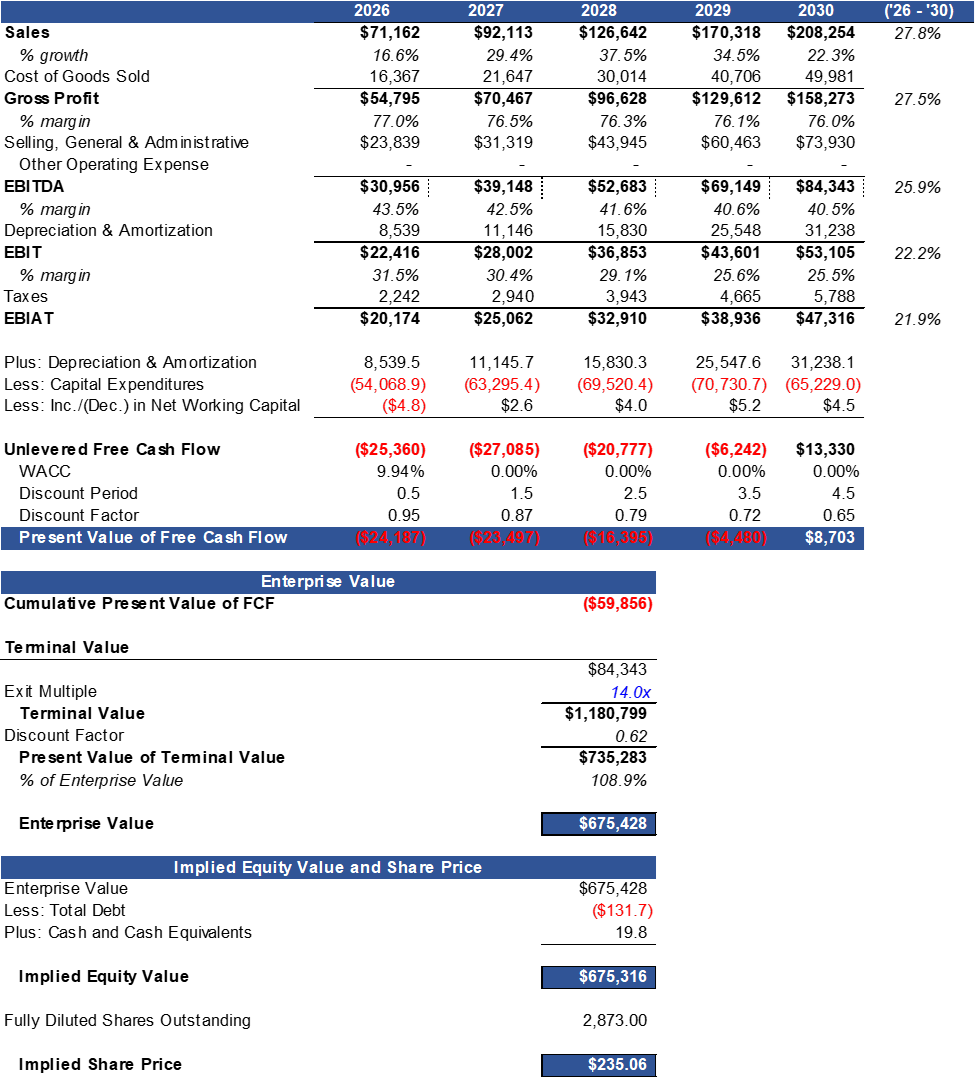
Industry | Diversified Hosting Services | Target Price | $235.06 |

BUSINESS MODEL
Products Oracle develops and sells enterprise software, cloud-based infrastructure, and hardware systems. Its core offerings include cloud applications (ERP, HCM, CX, and NetSuite), cloud infrastructure services (compute, storage, networking), database software, middleware, and enterprise management tools. The company also provides engineered systems and legacy on-premise software, along with technical support and consulting services that create recurring revenue streams. |
Customer Base Oracle primarily serves large enterprises, mid-sized businesses, and government organizations across global markets. Key customers include financial institutions, healthcare providers, telecom operators, retailers, manufacturers, and public-sector agencies. Through NetSuite and cloud applications, Oracle also targets growing small and mid-sized businesses. Demand is driven by digital transformation, cloud migration, data management, cybersecurity, and AI integration needs. |
Pricing Method Oracle generates revenue through subscription-based pricing for cloud applications and infrastructure services, typically structured as monthly or multi-year contracts. On-premise software is licensed upfront with ongoing support and maintenance fees. Cloud infrastructure is usage-based, priced according to computing power, storage, and network consumption. Enterprise agreements are often customized, especially for large-scale deployments, with negotiated pricing tiers and long-term commitments. |
Supply Chain Oracle relies on data center infrastructure, semiconductor manufacturers, hardware suppliers, and global energy providers to operate its cloud platforms. The company depends on skilled engineering talent for database development, cloud architecture, and AI capabilities. Strategic partnerships with system integrators, resellers, and technology vendors support implementation and ecosystem expansion. Capital investment in data centers and proprietary cloud infrastructure is central to maintaining scalability and performance. |
Sales Channels Oracle sells primarily through a direct enterprise sales force, supported by digital channels and global account teams. It also leverages channel partners, resellers, and system integrators for implementation and regional distribution. Cloud services are delivered digitally through Oracle’s global data center network, while support and updates are provided continuously through subscription agreements and over-the-air software upgrades. |
INDUSTRY ANALYSIS: PORTER'S 5 FORCES
Threat of New Entrants — Low Oracle operates in markets characterized by high capital intensity, deep technical expertise, and significant customer switching costs. Building a global cloud infrastructure platform or enterprise database ecosystem requires massive investment in data centers, software development, cybersecurity, and compliance. Long-standing customer relationships and mission-critical integration within enterprise IT systems create substantial barriers to entry, making large-scale new competition unlikely. |
Bargaining Power of Buyers — Moderate Large enterprise and government customers can negotiate pricing, particularly for multi-year cloud contracts and enterprise-wide deployments. Some customers adopt multi-cloud strategies to reduce dependence on a single vendor. However, high switching costs, integration complexity, and reliance on Oracle’s databases and enterprise applications limit buyer leverage once systems are embedded within core operations. |
Bargaining Power of Suppliers — Moderate Oracle depends on semiconductor manufacturers, hardware vendors, energy providers, and data center equipment suppliers to operate its cloud infrastructure. Certain suppliers, particularly advanced chip manufacturers, may have pricing power. However, Oracle’s scale, long-term contracts, and ability to design optimized cloud architecture reduce supplier influence. Skilled engineering talent in cloud and AI also represents a key input with competitive compensation pressure. |
Threat of Substitutes - Moderate Customers can substitute Oracle’s products with competing cloud providers, open-source databases, or alternative enterprise software vendors. Public cloud competitors and SaaS platforms offer comparable infrastructure and application services. Nevertheless, Oracle’s integrated database ecosystem, performance optimization, and enterprise entrenchment reduce the practical attractiveness of substitutes for many large organizations. |
Competitive Rivalry — High Oracle competes intensely in cloud infrastructure, enterprise applications, and database markets against well-capitalized global players. Competition is driven by pricing, performance, innovation in AI and cloud services, ecosystem integration, and global reach. While Oracle benefits from brand strength and a large installed base, rivalry remains strong due to rapid technological change and aggressive expansion by competitors. |
VALUATION: DISCOUNTED CASH FLOW

INVESTMENT RISKS
Systematic Risk |
Market Risk: Oracle’s exposure to market risk is moderate to high given its integration within the broader technology sector and enterprise IT spending cycles. As a large-cap technology company with significant cloud and infrastructure exposure, its stock performance is closely tied to overall equity market conditions and investor sentiment toward growth and AI-driven technology firms. In periods of economic slowdown or market correction, enterprise customers may delay IT spending or cloud migrations, which could pressure revenue growth and valuation multiples. As a result, Oracle’s share price is likely to move in line with broader technology market trends during periods of volatility. |
Geopolitical Risk: Oracle operates globally and is exposed to geopolitical tensions, trade restrictions, and regulatory fragmentation across jurisdictions. U.S.–China tensions, technology export controls, data localization laws, and sanctions regimes can affect its ability to sell cloud services, hardware, or software in certain regions. Additionally, data sovereignty requirements in Europe and other markets increase compliance costs and operational complexity. Any escalation in trade disputes, cybersecurity conflicts, or cross-border regulatory barriers could disrupt supply chains, limit market access, or increase infrastructure costs. |
Unsystematic Risk |
Business Risk: Oracle’s business risk stems primarily from intense competition in cloud infrastructure and enterprise software markets. The company is transitioning from legacy on-premise licensing toward subscription-based cloud services, which requires sustained capital investment and consistent innovation. Competitive pressure from hyperscale cloud providers and SaaS vendors may compress margins or slow customer acquisition. In addition, enterprise IT spending is cyclical; during economic slowdowns, customers may delay migrations or reduce discretionary software investments, affecting growth visibility. |
Financial Risk: From a financial standpoint, Oracle carries meaningful leverage relative to many technology peers due to its history of acquisitions and shareholder return programs. While operating margins and recurring subscription revenue provide stable cash generation, elevated debt levels increase sensitivity to interest rate movements and refinancing conditions. Debt-to-EBITDA and interest coverage metrics remain manageable, but the company’s capital structure introduces moderate financial risk compared to lower-levered cloud competitors. |
Liquidity Risk: Liquidity risk appears relatively contained. Oracle generates strong and consistent operating cash flow, supported by recurring cloud subscriptions and maintenance revenue. Cash balances and short-term investments, combined with ongoing cash generation, provide flexibility to meet near-term obligations. Although capital expenditures for data centers are significant, internal cash flow has historically been sufficient to fund operations, service debt, and return capital to shareholders without excessive reliance on short-term financing. |
Regulatory Risk: Oracle faces regulatory risk across multiple jurisdictions, particularly in data privacy, cybersecurity, antitrust oversight, and cross-border data transfer rules. Compliance with frameworks such as GDPR and other regional data protection laws increases operational complexity and costs. In addition, government scrutiny of large technology firms and evolving AI regulations could affect product deployment or contract structures. Export controls and geopolitical sanctions may also restrict access to certain markets or technologies, creating incremental regulatory exposure. |
MANAGEMENT
Clayton Magouyrk
Co-Chief Executive Officer & Director
Clayton has served in senior leadership at Oracle since 2014 and plays a central role in overseeing the company’s cloud infrastructure strategy and engineering operations. He previously worked as a Senior Engineer at Amazon.com and Amazon Web Services, where he gained experience in large-scale cloud architecture and distributed systems. His background in infrastructure engineering has been instrumental in scaling Oracle’s cloud platform and advancing its enterprise technology capabilities.
__________________________________________________________________________________
Michael D. Sicilia
Co-Chief Executive Officer & Director
Michael joined Oracle in 2014 and has held multiple leadership roles prior to assuming his current position in 2025. Earlier in his career, he served as Chief Technology Officer at Primavera Systems, Inc., where he led product and technology development for enterprise project management solutions. His experience spans enterprise software, cloud applications, and operational leadership. He completed his undergraduate studies at St. Joseph’s University.
__________________________________________________________________________________
Douglas A. Kehring
Chief Financial Officer & Executive Vice President
Douglas has been with Oracle since 2000 and has held senior financial leadership roles across the organization before assuming his current position in 2025. Over his tenure, he has overseen corporate operations and financial strategy, contributing to Oracle’s global expansion and capital allocation framework. Earlier in his career, he served as Director at The Dun & Bradstreet Corp. and as Vice President at Oracle America, Inc. He earned his undergraduate degree from the Wisconsin School of Business.
__________________________________________________________________________________
Larry Ellison
Chairman & Chief Technology Officer
Larry founded Oracle and has served in executive leadership since 1977, shaping the company’s strategy, technology vision, and long-term direction. He also serves in leadership roles at Cerner Corp. and is the founder of Tako Ventures LLC. Over the course of his career, he has been involved with several technology companies, including Apple, NetSuite, and Tesla, and has served on numerous boards. His influence has been central to Oracle’s development into a global enterprise software and cloud infrastructure leader.
__________________________________________________________________________________
Jae Evans, MBA
Global Chief Information Officer & Executive Vice President
Jae joined Oracle in 2020 and leads the company’s global information technology strategy and enterprise systems operations. She is responsible for overseeing digital transformation initiatives, internal technology infrastructure, and cybersecurity programs across the organization. Her leadership focuses on aligning IT capabilities with Oracle’s cloud-first strategy and operational efficiency goals.
__________________________________________________________________________________
Seema Verma
Executive Vice President & General Manager
Seema joined Oracle in 2024 after serving in senior leadership roles across healthcare and public policy. She previously led the Centers for Medicare & Medicaid Services (U.S.) as Administrator and has held board and executive positions at organizations including WellSky Corp., LifeStance Health, Monogram Health, and Lumeris. Her background spans healthcare policy, managed care, and health technology strategy. She earned a graduate degree from Johns Hopkins University and an undergraduate degree from the University of Maryland.
__________________________________________________________________________________
Stuart A. Levey
Chief Legal Officer & Executive Vice President
Stuart joined Oracle in 2022 after an extensive career spanning both the private and public sectors. He previously served as Chief Executive Officer of The Diem Association and DIEM Networks SARL, and held senior roles at HSBC Holdings Plc. Earlier in his career, he served as Under Secretary for Terrorism and Financial Intelligence at the U.S. Department of the Treasury and worked as a partner at Miller, Cassidy, Larroca & Lewin LLP. He earned his law degree from Harvard Law School and completed his undergraduate studies at Harvard College.
__________________________________________________________________________________
Maria Smith
Chief Accounting Officer & Executive Vice President
Maria has been with Oracle since 1999 and assumed her current role in 2022. She has held numerous leadership and board positions across Oracle’s international subsidiaries and affiliated entities, contributing to global financial oversight and governance. Prior to Oracle, she worked at Eontec Ltd., Fujitsu Consulting India Pvt Ltd., and Amdahl Ireland in financial and controller roles. She earned her undergraduate degree from Dublin City University.
__________________________________________________________________________________
Find Oracle's 10 Year Financial Statements below.


