INTUIT STOCK OVERVIEW

SNAPSHOT
Ticker | INTU | Market Cap | $112B |
Sector | Software and Consulting | P/E | 26.27 |
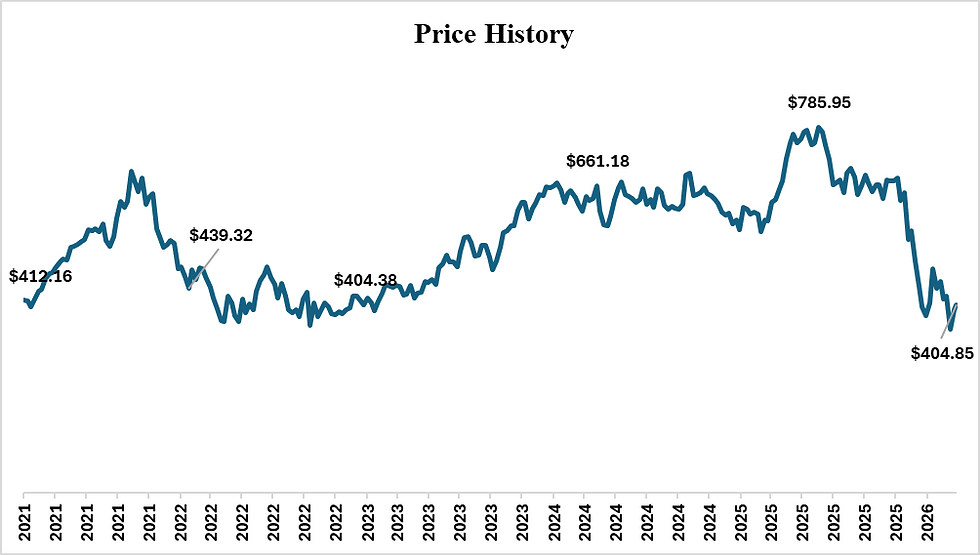
52 Week High-Low | $342.11 - $813.70 | 3 Year Beta | 0.87 |
CEO | Sasan K. Goodarzi | Target Price | $415.95 |
BUSINESS MODEL
Products Intuit operates a financial technology platform centered on an integrated ecosystem of software, services, and AI-driven solutions that serve consumers, small and mid-market businesses, and professional accountants. Its core offerings include QuickBooks for financial management, payments, payroll, and capital access; TurboTax for consumer and small business tax preparation; Credit Karma for personal financial management, credit monitoring, and financial product recommendations; and Mailchimp for marketing automation and customer engagement. The company is structured across four primary segments—Global Business Solutions, Consumer, Credit Karma, and ProTax—and is increasingly positioning itself as an AI-driven expert platform that combines proprietary data, artificial intelligence, and human experts to deliver automated workflows, predictive insights, and end-to-end financial decision support across the customer lifecycle. |
Customer Base Intuit serves approximately 100 million customers globally, including consumers, small and mid-market businesses, and accounting professionals, with a diversified base spanning multiple industries and geographies. Small businesses and accountants rely on QuickBooks and related services for daily financial operations, while consumers use TurboTax and Credit Karma for tax preparation and financial management. The platform model creates high engagement and switching costs as customers integrate multiple Intuit products into their workflows, particularly in accounting, payroll, and compliance functions. |
Pricing Method The company primarily uses a subscription-based and transaction-based pricing model, supplemented by service fees, financial product referrals, and payment processing revenue. Pricing is driven by product tiering, feature sets, usage volume, and value-added services such as expert assistance and AI-enabled automation. This recurring revenue structure provides strong visibility and scalability while enabling cross-selling across the ecosystem. |
Supply Chain Intuit’s supply chain is digital and cloud-based, relying on infrastructure providers such as AWS and Google Cloud to deliver software and services globally. Product development is primarily internal, supported by acquisitions and third-party integrations that expand capabilities and accelerate innovation. The company leverages proprietary data, AI infrastructure, and partner ecosystems including financial institutions, lenders, and service providers to deliver integrated financial solutions. |
Sales Channels Sales are primarily conducted through direct digital channels including websites, mobile applications, and online platforms, supported by assisted sales, partner integrations, and professional networks such as accountants and advisors. Intuit also leverages multi-channel distribution, including partnerships with financial institutions and online marketplaces, to expand reach and drive adoption, while cross-selling within its ecosystem enhances customer lifetime value. |
INDUSTRY ANALYSIS: PORTER'S 5 FORCES
Threat of New Entrants — Moderate Barriers to entry are moderate due to the need for scale, data infrastructure, regulatory compliance, and brand trust in financial services, but new entrants leveraging AI and fintech innovation can still enter niche segments. Intuit’s integrated platform, brand recognition, and data advantage reduce the threat but do not eliminate it. |
Bargaining Power of Buyers — Moderate Customers have alternatives across accounting software, tax preparation, and fintech platforms, but switching costs increase significantly once integrated into workflows, particularly for businesses and accountants. This reduces price sensitivity over time, though initial buyer choice remains competitive. |
Bargaining Power of Suppliers — Low Supplier power is limited because Intuit relies primarily on scalable cloud providers and internal development capabilities. While dependence on cloud infrastructure exists, the company’s scale and multi-provider approach mitigate concentration risk. |
Threat of Substitutes — High Substitution risk is high due to numerous alternatives including competing fintech platforms, traditional accounting firms, tax professionals, and emerging AI-driven solutions. Customers can shift between software platforms or revert to manual or outsourced solutions depending on cost and complexity. |
Competitive Rivalry — High Competition is intense across all segments, with rivals ranging from large enterprise software firms to fintech startups and specialized service providers. Competition is driven by innovation, AI capabilities, user experience, pricing, and ecosystem integration, requiring continuous investment to maintain leadership. |
VALUATION: DISCOUNTED CASH FLOW


WACC

INVESTMENT RISKS
Systematic Risk |
Market Risk:Intuit trades at a P/E of 26.27 and EV/EBITDA of 18.83 with a WACC of 7.92%, reflecting a premium but more normalized valuation relative to historical highs. Profitability remains strong with gross margins at 77.65% and operating margins improving to 27.09% in 2026, while net margin stands at 21.57%. However, valuation remains sensitive to growth expectations, particularly given prior multiple expansion and dependence on continued revenue growth and AI-driven monetization. Any slowdown in growth or margin expansion could lead to valuation compression. |
Geopolitical Risk: Geopolitical risk is moderate given global operations, regulatory exposure, and reliance on international customers and partners. While international revenue is only about 8%, global regulatory frameworks, tax laws, and financial compliance requirements create exposure to cross-border policy changes and operational constraints. |
Unsystematic Risk |
Business Risk: Business risk is driven by rapid technological change, competitive pressure, and execution of the AI-driven platform strategy. While free cash flow margins are strong at 33.99% and conversion remains high at 128.20%, the company must continuously innovate to maintain relevance in a fast-evolving fintech landscape. Return on invested capital has declined from historical peaks to 17.57%, indicating reduced capital efficiency compared to earlier years, and asset turnover remains relatively low at 0.61, reflecting a platform model that requires sustained growth to justify capital deployment. |
Financial Risk: Financial risk is low, supported by conservative leverage and strong coverage ratios. Net debt to EBITDA is approximately 0.51x and total debt to EBITDA is 0.98x, while EBIT covers interest expense by 22.43x, indicating significant financial flexibility and low solvency risk. The balance sheet is strong, with limited reliance on debt financing. |
Liquidity Risk: Liquidity risk is moderate, with a current ratio of 1.32 and quick ratio of 1.32, indicating adequate short-term coverage but not excessive liquidity. CFO to current liabilities stands at 78.96%, suggesting solid but not exceptional operating cash support. Liquidity is sufficient but dependent on continued strong cash generation. |
Regulatory Risk: Regulatory risk is elevated due to exposure to tax laws, financial services regulations, data privacy rules, and compliance requirements across multiple jurisdictions. Intuit’s products in tax preparation, payments, lending, and personal finance are subject to ongoing regulatory scrutiny, and changes in tax policy or financial regulations could materially impact product demand, compliance costs, and operational complexity. |
MANAGEMENT
Sasan K. Goodarzi
Chairman, President & Chief Executive Officer
Sasan has served as Chairman, President, and CEO of Intuit since 2026 and has been with the company since 2004, holding leadership roles including leading the Small Business and Self-Employed segment and serving as Executive Vice President of the Consumer Group. He previously held executive roles at Invensys and Resource Innovations and serves on the board of Atlassian. He holds an undergraduate degree from the University of Central Florida and an MBA from the Kellogg School of Management.
__________________________________________________________________________________
Sandeep S. Aujla
Chief Financial Officer & Executive Vice President
Sandeep has served as CFO since 2023 and has been with Intuit since 2015, bringing experience in finance, strategy, and operations. He holds an MBA from the University of Virginia Darden School of Business and plays a key role in capital allocation and financial strategy.
__________________________________________________________________________________
Alex Balazs
Chief Technology Officer & Executive Vice President
Alex serves as CTO and leads Intuit’s technology strategy, infrastructure, and platform development. His role focuses on advancing the company’s AI-driven capabilities and scaling its cloud-based ecosystem.
__________________________________________________________________________________
Greg Johnson
Chief Commercial Officer & Executive Vice President
Greg has served as Chief Commercial Officer since 2024 and previously served as CEO of McAfee. He is responsible for driving go-to-market strategy, revenue growth, and commercial execution across Intuit’s global operations.
__________________________________________________________________________________
Marianna Tessel
Executive Vice President & General Manager – Small Business Group
Marianna leads the Small Business segment and has been with Intuit since 2017. She previously held senior leadership roles at Docker, VMware, and SAP, and brings deep experience in product development and enterprise software strategy.
__________________________________________________________________________________
Mark Notarainni
Executive Vice President & General Manager – Consumer Group
Mark has been with Intuit since 2009 and leads the Consumer segment, overseeing TurboTax and related offerings. He brings extensive experience in consumer product strategy and execution within financial technology.
__________________________________________________________________________________
Find Intuit's 10 Year Financial Statements below.


