AMGEN STOCK OVERVIEW

SNAPSHOT
Ticker | AMGN | Market Cap | $186B |
Sector | Biopharmaceuticals | P/E | 24.21 |
52 Week High-Low | $261.43 - $391.29 | 3 Year Beta | 0.58 |
CEO | Robert A. Bradway | Target Price | $376.19 |

BUSINESS MODEL
Products Amgen operates as a biotechnology company focused on discovering, developing, manufacturing, and commercializing innovative biologic medicines targeting high unmet medical needs across oncology, cardiovascular disease, inflammation, bone health, and rare diseases. Its portfolio includes both original biologics and biosimilars, with key products such as Enbrel, Prolia, XGEVA, Repatha, Otezla, and a growing pipeline of first-in-class and next-generation therapies. The company’s model is built on high-margin biologics supported by long development cycles, patent protection, and regulatory exclusivity, enabling premium pricing and durable revenue streams while leveraging scientific expertise in molecular biology and protein engineering to sustain innovation and pipeline replenishment. |
Customer Base Amgen serves a global healthcare ecosystem including physicians, hospitals, clinics, dialysis centers, and pharmacies, with distribution heavily concentrated through pharmaceutical wholesalers such as McKesson, Cencora, and Cardinal Health, which collectively account for a substantial majority of U.S. distribution. The company operates in approximately 100 countries, with the United States representing the largest market at roughly 73% of product sales, while the remainder is generated internationally through a mix of direct operations and partnerships. |
Pricing Method Pricing is driven by value-based and reimbursement-dependent models, with biologic drugs priced at a premium reflecting clinical efficacy, innovation, and lack of substitutes, while subject to negotiations with payers, pharmacy benefit managers, and government programs such as Medicare and Medicaid. Revenue realization depends on reimbursement frameworks, rebates, and discounts, making pricing both highly regulated and strategically negotiated across markets. |
Supply Chain Amgen maintains a vertically integrated supply chain encompassing research and development, biologics manufacturing, and global distribution, with specialized facilities for complex biologic production and reliance on high-quality raw materials and strict regulatory compliance. Manufacturing complexity and regulatory oversight create high barriers to entry but also introduce operational risk tied to production scale, quality control, and supply continuity. |
Sales Channels Sales are primarily conducted through large pharmaceutical wholesalers in the United States and through a combination of direct sales forces, affiliates, and third-party partnerships internationally. Marketing targets healthcare providers directly, supplemented by selective direct-to-consumer advertising in the U.S., while international commercialization often involves regional partners to navigate regulatory and distribution complexities. |
INDUSTRY ANALYSIS: PORTER'S 5 FORCES
Threat of New Entrants — Low Barriers to entry in biotechnology are extremely high due to the combination of long drug development timelines, substantial capital requirements, and stringent regulatory approval processes. Bringing a biologic drug to market can take over a decade and require billions in investment, with no guarantee of success. In addition, Amgen benefits from a deep patent portfolio and regulatory exclusivity that protect its products from direct competition for extended periods. The complexity of biologics manufacturing, which requires specialized facilities and expertise, further discourages new entrants. While smaller biotech firms can emerge with innovative therapies, scaling to compete with a company like Amgen across multiple therapeutic areas remains highly challenging. |
Bargaining Power of Buyers — High Buyers such as insurers, pharmacy benefit managers, and government healthcare programs have significant influence over drug pricing and access. These entities negotiate rebates and determine formulary placement, which directly impacts a drug’s commercial success. In the U.S., a small number of large wholesalers dominate distribution, adding another layer of concentration and bargaining power. Globally, many countries impose strict pricing controls and reimbursement limits, further constraining pricing flexibility. Although Amgen can command premium pricing for innovative therapies with strong clinical benefits, this power erodes over time as alternative treatments and biosimilars enter the market and buyers push for lower costs. |
Bargaining Power of Suppliers — Moderate Suppliers provide critical inputs such as biologic raw materials, specialized manufacturing equipment, and research services. While some inputs are highly specialized and not easily substitutable, Amgen’s scale, long-term supplier relationships, and partial vertical integration reduce dependence on any single supplier. The company’s ability to manufacture many of its own products also limits supplier leverage. However, supply chain disruptions, quality issues, or reliance on niche inputs can still create operational risks, keeping supplier power at a moderate level. |
Threat of Substitutes — High Substitution risk is significant in the pharmaceutical industry, as multiple therapies often exist for the same condition, including competing biologics, small-molecule drugs, and non-drug treatments. As patents expire, biosimilars provide lower-cost alternatives that can quickly capture market share. In some cases, entirely new treatment approaches or breakthrough therapies can displace existing products. This constant innovation cycle forces Amgen to continuously invest in R&D to maintain its competitive position and replace declining revenue from older drugs. |
Competitive Rivalry — Very High The biotechnology and pharmaceutical industry is highly competitive, with numerous large global firms and emerging biotech companies competing across similar therapeutic areas. Rivalry is driven by innovation, clinical trial success, speed to market, and pricing strategies. Companies compete not only for market share but also for pipeline assets, partnerships, and acquisitions. High fixed costs in R&D and the importance of blockbuster drugs intensify competition, as firms must continually produce successful therapies to sustain growth. As a result, Amgen faces constant pressure to innovate, defend its intellectual property, and maintain strong commercial execution. |
VALUATION: DISCOUNTED CASH FLOW


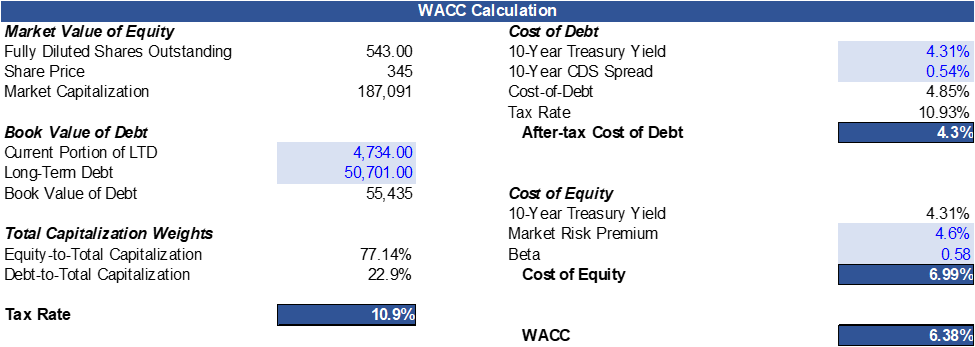
WACC
INVESTMENT RISKS
Systematic Risk |
Market Risk: Amgen trades at a P/E of 24.21, EV/EBITDA of 14.71, and WACC of 6.31%, reflecting a mature growth profile with moderate valuation sensitivity to pipeline success and patent cycles. Profitability remains strong with gross margins at 70.47%, operating margins at 27.93%, and net margins at 20.99% in 2025, but margins have declined from historical peaks, indicating increasing pricing pressure and cost intensity. Free cash flow margins have compressed to 22.05% from prior levels above 40%, signaling reduced cash generation efficiency despite still strong absolute profitability. |
Geopolitical Risk: Geopolitical risk is moderate to high given global operations across approximately 100 countries, exposing Amgen to regulatory divergence, pricing controls, trade policies, and currency fluctuations, particularly in markets with strict drug pricing regulation and reimbursement constraints. |
Unsystematic Risk |
Business Risk: Business risk is high due to dependence on a concentrated portfolio of biologic drugs with finite patent lives, creating exposure to patent cliffs and biosimilar competition. Return on invested capital has declined to 12.59% and asset turnover remains low at 0.40, reflecting capital intensity and long development cycles. Earnings volatility is evident with net margins fluctuating significantly, including a drop to 12.31% before recovering, highlighting sensitivity to product cycles and R&D outcomes. |
Financial Risk: Financial risk is elevated with net debt to EBITDA at 2.95x and total debt to EBITDA at 3.54x, indicating meaningful leverage relative to cash flow generation. Interest coverage remains adequate at 3.67x EBIT/interest but is materially lower than software or asset-light sectors, suggesting sensitivity to rising interest rates and refinancing conditions. |
Liquidity Risk: Liquidity risk is moderate, with a current ratio of 1.14 and quick ratio of 0.90, indicating sufficient but not excessive short-term liquidity. CFO to current liabilities at 39.07% suggests reliance on ongoing operating cash flow to meet obligations rather than excess balance sheet liquidity. |
Regulatory Risk: Regulatory risk is very high due to heavy dependence on FDA approvals, global regulatory bodies, and reimbursement frameworks, as well as exposure to drug pricing legislation, patent law, and compliance requirements. Any adverse regulatory changes, delays in approvals, or pricing reforms could materially impact revenue and profitability. |
MANAGEMENT
Robert A. Bradway
Chairman, President & Chief Executive Officer
Robert has served as Chairman and CEO since 2012 and has been with Amgen since 2006, previously holding roles in operations and strategy. He also serves on the board of Roundtable on Cancer and has prior experience at Morgan Stanley. He holds an undergraduate degree from Amherst College and an MBA from Harvard Business School.
__________________________________________________________________________________
Esteban Santos
Executive Vice President, Operations
Esteban has served as EVP of Operations since 2016 and joined Amgen in 2007, previously working at Johnson & Johnson. He holds a degree from Rensselaer Polytechnic Institute and has extensive experience in global manufacturing and supply chain operations.
__________________________________________________________________________________
Peter H. Griffith
Chief Financial Officer & Executive Vice President
Peter has served as CFO since 2020, with prior leadership roles at Ernst & Young and Sherwood Canyon Group, bringing extensive experience in corporate finance and investment banking. He holds a degree from USC Marshall School of Business.
__________________________________________________________________________________
Howard Y. Chang
Chief Scientific Officer & SVP, Global Research
Howard joined Amgen in 2024 and is a leading scientific researcher with prior founding roles in multiple biotech firms and affiliations with Harvard and MIT, holding a doctorate from Harvard Medical School.
__________________________________________________________________________________
Sean Bruich
Senior Vice President, Artificial Intelligence & Data
Sean joined Amgen in 2024 and leads AI and data strategy, focusing on integrating advanced analytics into research and operations.
__________________________________________________________________________________
James E. Bradner
Executive Vice President, Research & Development
James joined Amgen in 2023 and previously founded Acetylon Pharmaceuticals and held leadership roles at Novartis, bringing deep expertise in drug discovery and translational medicine.
__________________________________________________________________________________
Find Amgen's 10 Year Financial Statements below.


